
Meta Description Tags
Meta Description Tags
Effective Date: March 2, 2026
Last Updated: March 6, 2026
Hibu Policy
Each visible page must include one unique meta description that:
- Targets 150–160 characters
- Prioritizes key messaging within the first 110–120 characters
- Aligns directly with page content and intent
- Encourages click-through from search results
Meta descriptions must be written in sentence case and must read as persuasive supporting copy to the title tag.
Definition
A meta description is the HTML <meta name="description">element that provides a summary of a web page.
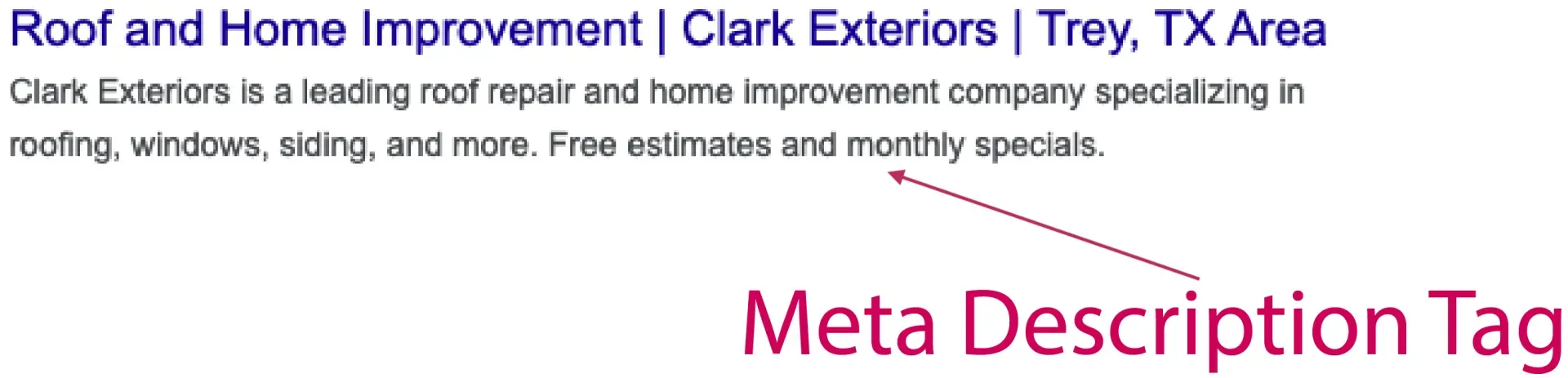
It appears beneath the title tag in search engine results and often serves as the supporting copy in link previews when a page is shared.
Example HTML structure:
<meta name="description" content="Short summary of the page content written to encourage users to click.">
The meta description represents the page’s value proposition before a user visits the site. It should clearly explain what the page offers and why it is relevant.
Unlike title tags, meta descriptions are not a direct ranking factor. However, they significantly influence click-through rate (CTR), which affects overall search performance.
Purpose / Why It Matters
Meta descriptions serve as the supporting copy in the search result listing.
They:
- Clarify what the user will find on the page
- Reinforce keyword relevance
- Differentiate the listing from competitors
- Encourage action
- Support conversion before page load
In many cases, the meta description determines whether a user clicks or scrolls past.
Current Display Standards
Search engines do not impose a strict technical character limit. However, they do have what is considered an optimum range. This is what informs our character-length standards at Hibu: Therefore, the following practical display limits apply.
- Desktop display typically truncates around 155–160 characters.
- Mobile truncates earlier.
- Ideal writing range: 150–160 characters.
- Critical information must appear in the first 110–120 characters.
Because truncation is common, front-loading with valuable keywords is required.
Structure Guidelines
- Front-Load Keywords
- Place the most important terms at the beginning.
- Align with Page Intent
- The title must match the specific page content.
- Include Name of Business (When Required)
- Include NOB on:
- Homepage
- Contact
- About
- Utility pages
- Strategic Use of Business Name & Geographic Modifiers (When Not Required)
- For pages not listed above, the Name of Business (NOB) is not required. However, when space and context allow, it may be included strategically.
- Meta descriptions on service, category, or geo-focused pages may also incorporate:
- Secondary Geo (when relevant to page intent)
-OR- - Primary Geo
- This is encouraged when it:
- Strengthens local search relevance
- Improves clarity in search results
- Reinforces brand recognition
- Aligns naturally with the page topic
- Do not force business names or geographic modifiers into the description if they reduce clarity, feel repetitive, or read unnaturally.
- Primary and secondary geo definitions are governed by the Hibu Geo Rules.
- Maintain Sentence Case
- Meta descriptions must be written in sentence case.
- Avoid:
- All caps (unless acronym: AAA, ASE)
- Excessive punctuation
- Overuse of exclamation marks
- Avoid These Common Mistakes
- Keyword stuffing
- Repeating the title tag verbatim
- Generic summaries (“Welcome to our website…”)
- Writing only for search engines
- Misalignment with page content
- Duplicate meta descriptions across pages
- Each meta description must be meaningfully distinct.
Google Rewrites & Truncation Considerations
Google may rewrite meta descriptions if:
- They do not match the search query
- They are too vague
- They appear keyword-stuffed
- On-page copy better answers the query
Clear, relevant, intent-matched copy reduces rewrite likelihood.
Page-Type Variations
Meta descriptions are structured differently depending on page type.
While all meta descriptions must:
- Stay within 150–160 characters
- Front-load key messaging
- Encourage click
Structure and tone may vary for:
- Home / Category Landing Page(s)
- Core Service / Product pages
- Contact / Location pages
- Service Area Pages (SAPs)
- GEO Pages
- Out-of-Norm pages (Careers, Coupons, Finance, Gallery, FAQs, etc.)
Always refer to the page-specific formatting guideline before writing or editing. Page-specific rules override general structure when applicable.